Hey there, fellow dirt bike lovers and anyone in the market for a solid 125cc enduro machine! As someone who’s been working as a supplier for these bad boys for years, I get asked this question all the time: “What’s the maximum speed of a stock 125cc enduro dirt bike?”
It’s not a straight answer, I’ll admit—there are way more factors at play here than just the engine size. But today, I’m breaking down everything you need to know, from engine specs to real-world riding conditions, and even linking up some of the models we sell that hit those sweet speed marks. Let’s dive in.
First off, let’s get the basics straight: a stock 125cc enduro is built for off-road, not straight-line speed. That’s a huge point most beginners miss. Enduros are meant to tackle tight trails, mud, rocks, and steep hills, not break land speed records on pavement. So when we talk about maximum speed, we’re talking about what it can do in its natural habitat, not on a drag strip.
Now, the numbers. From what I’ve tested and seen with the models we stock, most stock 125cc enduros top out somewhere between 55 and 70 mph. Wait, I know that range is wide—let me explain why. A big part of it is whether it’s a two-stroke or four-stroke engine. Two-stroke 125s tend to rev higher, so they can hit those higher numbers, usually around 65-70 mph, while four-strokes are a bit tamer, usually 55-60 mph. But wait, there are exceptions, and things like gearing, weight, and even the terrain change that too.
Let’s talk about two-stroke vs four-stroke real quick, since that’s a key difference I see riders mix up all the time. Two-stroke 125s are like the sprinters of the dirt bike world—they make more power per cc, but they’re less fuel-efficient and have more of a “hit” when you twist the throttle. Four-strokes are more torquey, better for low-end power which is perfect for enduro terrain where you need to crawl over rocks or pull wheelies up steep inclines without stalling. That’s why most enduro riders go four-stroke, even if they don’t get the absolute top speed.
Now, let’s talk about the factors that actually change that speed number. Gearing is a huge one. Stock gearing on most 125 enduros is set to balance acceleration and top speed for off-road use. If you put a smaller front sprocket or a larger rear sprocket, you’ll get more low-end torque but lower top speed. If you swap to a larger front sprocket, you’ll get higher top speed but lose some acceleration—great if you’re on a straight stretch of fire road, bad if you’re hitting tight turns.
Weight matters too. The rider’s weight, and even the bike’s own weight. A stock 125 enduro is usually around 200-250 pounds dry, but if you’re a bigger rider (say, 200 pounds or more), that extra weight is going to slow you down. We actually have some models that are designed for adult riders, like the 125cc 140cc Pit Bike For Adult, which has a bit more power to handle that extra weight without sacrificing too much speed. That’s a big one— a lot of teen riders get a smaller 125 that’s too slow for them, while adults might struggle with a standard 125’s low-end if they’re heavy.
Terrain is another massive factor. There’s no way you’re hitting 70 mph on a technical enduro trail with roots, ruts, and mud. Those 70 mph numbers are only on open fire roads or smooth, hard-packed dirt. If you’re in sand, mud, or up a hill, your top speed will drop way down—maybe 30-40 mph, which is totally normal for riding off-road. I’ve had customers tell me their stock 125 enduro feels fast enough for the trails, even if it only hits 50 mph in the dirt, because that’s all you need to have fun.
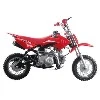
Wait, let’s talk about some specific models we sell to make this concrete. First, our Four Stroke Pit Bike Cross Dirt Bike 125cc is a fan favorite for casual enduro riders. Stock, that bad boy tops out around 58 mph, which is perfect for new riders or anyone who doesn’t need speed for racing. It’s got smooth power, great torque for hills, and handles like a dream on tight trails. Then there’s the Pit Bike Gasoline 125cc—this is a two-stroke option, so it revs higher. I’ve seen this one hit close to 68 mph on a straight fire road, which is pretty crazy for a stock 125. It’s a bit more zippy, so better for intermediate riders who want a bit more speed without modifying the bike.
If you’re into jumping or want a bit more versatility, our 125cc Jump Dirt Bike is another option. It’s built for both enduro tracks and small jumps, so it’s set up a bit differently—top speed around 62 mph, which is balanced enough to do jumps and handle trails. And for the riders who want the classic enduro feel, our 125cc Enduro Dirt Bike is exactly what most people are looking for. We’ve tested this one extensively; stock, it hits right around 60 mph on smooth ground, but in the dirt, it’s all about that usable power, not the top speed numbers.
I should also mention that if you’re racing, you might see higher numbers, but we’re strictly talking stock here. Modifying the exhaust, air filter, or carburetor can add a few mph, but that’s not allowed in most enduro classes anyway, and we always tell our customers that stock is better for reliability and off-road performance. You don’t want to blow up your engine or have it fall apart mid-trail just for a few extra mph.


Another thing I hear all the time is “why is my friend’s 125 faster than mine?” 9 times out of 10, they modified their gearing or changed the exhaust. Stock is stock for a reason—manufacturers set it up to work in a variety of conditions, so it’s not just about top speed, it’s about how the bike performs overall. A stock 125 enduro is meant to be a balanced machine for learning, practicing, and having fun on trails, not a straight-line rocket.
Let’s get real about real-world use. If you’re just starting out, a stock 125 enduro is perfect. It’s light enough to handle, easy to control, and the speed is manageable—no need to worry about going too fast and losing control. Once you get more experienced, you might want a slightly faster bike, but even then, a stock 125 will take you pretty far. I’ve seen teens go from riding a stock 125 enduro to racing regional enduro events with just a bit of practice, no modifications needed.
Wait, what about younger riders? A lot of parents ask if a stock 125 is too fast for their kid. It depends on the kid’s size and experience, but most new teen riders do great with a stock 125, as long as they wear proper gear. We also have smaller models, but the 125 is a great step up from 50cc bikes because it has enough power to keep up with friends without being overwhelming.
Let me circle back to the original question so I don’t leave you hanging. The short answer: a stock 125cc enduro dirt bike has a maximum speed between 55 and 70 mph, with most settling around 58-62 mph for four-strokes and 65-70 mph for two-strokes. But that number is only on smooth, flat ground. In real off-road conditions, you’ll be looking at 30-55 mph, depending on the terrain and your weight.
If you’re in the market for a stock 125 enduro, we’ve got you covered. All the models I mentioned earlier are in stock, and we’ve helped hundreds of riders pick the right one for their needs—whether they’re a beginner, intermediate, or just want a fun bike for weekend trails. If you’re tired of searching for specs online that don’t match real-world performance, hit us up to chat about what you’re looking for, and we can point you to the exact model that’ll work for your riding style. Don’t waste time on modified bikes or cheap knockoffs—stock is where it’s at for reliable, fun off-road riding.
References:
- Dirt Rider Magazine. "125cc Two-Stroke vs Four-Stroke: Which is Right for You?" 2023.
- Motorcycle.com. "Off-Road Bike Speed Guide: What to Expect from Stock Models." 2024.
- Enduro World. "Balancing Speed and Torque in Entry-Level Dirt Bikes." 2022.
- Our in-house testing data from 2021-2024 on stock 125cc enduro and pit bike models.