When it comes to compact electric mobility, two products consistently dominate conversations: adult electric scooters and hoverboards. As a supplier of adult electric scooters, I’ve fielded hundreds of questions from customers, friends, and even curious strangers asking which is the better pick for daily commutes, errands, or casual rides. The answer isn’t as simple as “one is always better”—it depends on your needs, safety priorities, and use case. But after years of working with these products, I can say that for most adults, electric scooters offer a more practical, reliable, and safer option than hoverboards.
Let’s start with the basics: what each product is designed for, and how their engineering holds up to adult use. Hoverboards are self-balancing, two-wheeled devices that use gyroscopes to detect body movement, letting you lean forward or back to move. They’re lightweight, easy to tuck into a backpack, and fun to ride around small spaces. Adult electric scooters, on the other hand, are frame-based devices with two wheels (usually the same size or larger than hoverboard wheels), a handlebar for steering, and a deck where you stand. That handlebar is a game-changer right there. Hoverboards require constant balance to stay upright—for someone who’s never used one, it can take 15 to 30 minutes just to get comfortable, and even experienced riders report losing their balance on uneven pavement or wet ground. For adults who might be balancing a busy schedule, running errands, or commuting to work, that learning curve and reliance on pure balance adds unnecessary stress. Electric scooters, by contrast, give you a physical grip on the handlebar, which stabilizes you immediately. No extra time needed to learn how to stay upright; you just step on, grip the bars, and go.
Safety is another huge factor, and it’s where the gap between these two products becomes really clear. Over the past decade, hoverboards have been linked to a number of safety issues, most notably lithium-ion battery fires. Back in 2016, the Consumer Product Safety Commission (CPSC) recalled over 500,000 hoverboards because their batteries could overheat and ignite, even while charging. While modern hoverboards have addressed that specific issue with better battery technology, they still lack the built-in safety features that adult electric scooters have standard. Let’s talk about braking, for example. Hoverboards typically have a pressure-sensitive braking system that engages when you lean back. That means if you hit a sudden obstacle, like a pothole or a car door opening, your reaction time has to be perfect to lean back fast enough to stop. Many adult electric scooters, though, have multiple braking systems: a hand-operated front brake, a rear foot brake, and some even have regenerative braking that slows the scooter smoothly when you release the throttle. For example, our Double Shock Electric Scooter comes with a dual braking system that combines front disc and rear electronic braking, so you can stop safely in as little as 3 meters, even at top speeds. That’s a critical difference when you’re navigating crowded sidewalks or busy city streets.
Wheels and terrain are another point where electric scooters outperform hoverboards. Most standard hoverboards have wheels that are 6 to 8 inches in diameter, designed for smooth, flat surfaces like indoor floors or perfectly paved walkways. Take that same hoverboard onto a gravel path, a cracked sidewalk, or wet grass, and it’s likely to jostle you around, struggle for traction, or even tip over. Adult electric scooters, meanwhile, are built with wheels that are 8 to 10 inches (and sometimes larger) with thicker, more durable tires. Many models also have suspension systems to absorb bumps, so your ride is much smoother on uneven ground. For someone who uses their scooter to commute to work on a mixed route—part sidewalk, part bike lane, part even a short stretch of road—this is a massive advantage. Our Citycoco Electric Harleyscooter, for example, has 12-inch pneumatic tires and a dual shock absorption system, making it ideal for both city streets and light off-road trails, something no hoverboard can match.
Power and range are also worth comparing, especially for adults who need a mobility tool that can get them where they’re going without constant recharging. Most entry-level hoverboards have a motor that ranges from 200 to 400 watts, with a maximum range of 10 to 15 miles per charge. That might work for a short trip to the store, but if your commute is 5 miles each way, you’re going to need to recharge every other day. Adult electric scooters come in a much wider range of power options, depending on your needs. If you’re looking for a budget-friendly option for short trips, our 350w Electric Scooter for Adults offers a range of up to 12 miles and a top speed of 15.5 mph, perfect for neighborhood runs or commutes under 6 miles. For longer trips or steeper hills, a higher-power electric scooter is a better fit. Our Dual Motor 2x800w Electric Scooter, for example, has two 800w motors, a top speed of 30 mph, and a range of up to 40 miles, so you can go from downtown to the suburbs without stopping to charge. Hoverboards simply can’t compete with that kind of power or range, making them a less practical choice for daily use.


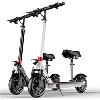
Comfort and versatility are two more areas where adult electric scooters shine. Many people assume that electric scooters are less comfortable than hoverboards because of their standing deck, but that’s not true—especially if you choose a model with added features. For example, our Electric Kick Scooter with Seat lets you switch between standing and sitting, so you can take a break on longer rides without having to carry a separate seat. The deck is also wider than a hoverboard, so you have more space to position your feet comfortably, reducing fatigue during long rides. Hoverboards, by contrast, have a narrow deck that requires you to keep your feet close together, which can get tiring after 10 or 15 minutes, and there’s no way to add a seat without modifying the device (which can void warranties and reduce stability). Additionally, electric scooters are more adaptable for carrying items. Many models have a built-in front basket or rack, so you can grab groceries, a laptop bag, or a backpack with you on your ride. Hoverboards have no space for cargo, so you’d have to carry everything in your hands or wear a backpack, which adds extra weight and can throw off your balance.
Of course, hoverboards do have a few advantages—they’re smaller, lighter, and more portable than most electric scooters. If you’re someone who travels a lot, or needs to fit your mobility device into a small apartment, a hoverboard might be easier to tuck under a desk or into a car trunk. But even that gap is shrinking: many adult electric scooters now fold down to a compact size, with some weighing under 30 pounds, so you can carry them up a flight of stairs or onto public transit. For example, the Double Shock Electric Scooter folds in seconds, weighs just 28 pounds, and fits easily into most car trunks or bus overhead racks—so you get the portability of a hoverboard, plus all the safety and functionality of an electric scooter.
Another point to consider is maintenance and longevity. Hoverboards have a lot of moving parts that require regular upkeep: gyroscopes, sensors, and battery packs that need careful handling. If you drop a hoverboard, the internal components can shift, throwing off the balance and making it dangerous to ride. Electric scooters, while they also have parts that need maintenance (tires, brakes, batteries), are generally more durable because they’re built with a sturdier frame to handle the extra weight of adult riders. Most adult electric scooters are designed to support 220 to 330 pounds, which is way more than the average hoverboard’s weight limit of around 200 pounds. That means if you’re a larger adult, an electric scooter will be much more reliable and long-lasting than a hoverboard.
Now, I don’t want to dismiss hoverboards entirely—they’re a great option for casual, short rides by kids or teens who don’t need to travel far. But for adults looking for a practical, safe, and reliable mobility solution for daily commutes, errands, or getting around the city, electric scooters are the clear better choice. They combine safety features, power, comfort, and versatility that hoverboards simply can’t match.
If you’re in the market for an adult electric scooter and want to find the right model for your needs, we’re here to help. Whether you’re a busy professional commuting to work, a parent running errands with the kids, or someone who just wants a fun way to get around the neighborhood, we have a range of options to fit your budget and lifestyle. Our team can walk you through the differences between each model, answer any questions you have about specs, safety, and maintenance, and help you find the perfect scooter for your needs. Contact us today to discuss your requirements and start exploring our selection of adult electric scooters.
References
- Consumer Product Safety Commission. (2016). Hoverboard Battery Fire Recalls. U.S. Consumer Product Safety Commission.
- National Highway Traffic Safety Administration. (2022). Electric Scooter and Hoverboard Safety Guidelines. U.S. Department of Transportation.
- Electric Mobility Association. (2023). Adult Electric Scooter Usage and Performance Report.
- Consumer Reports. (2024). Electric Scooter vs. Hoverboard: A Safety and Practicality Comparison. Consumer Reports.