If you’ve ever stepped into a kids’ pit bike shop or scrolled through online listings for bikes that are safe, fun, and age-appropriate for young riders, you’ve probably seen two common engine types for 50cc models: 2-stroke and 4-stroke. As a supplier of 50cc Pit Bike for Kids, I get dozens of questions every week from parents, small bike shops, and even beginner riders themselves asking exactly how these two designs differ—and which one is better for a kid just starting out. It’s not just about engine specs; it’s about safety, ease of use, maintenance, and how the bike performs when your child is learning to navigate trails, parking lots, or small race tracks. Let’s break it down without the confusing jargon, so you can make an informed choice.

First, let’s start with the basics of how each engine works, because that’s where all the differences stem from. A 50cc engine measures its “displacement”—the volume of air and fuel the piston moves in one stroke—at 50 cubic centimeters, but how that air-fuel mix turns into power is totally different between 2-stroke and 4-stroke designs.
A 2-stroke engine completes all four key steps of a combustion cycle—intake, compression, combustion, and exhaust—in just two piston strokes (one up, one down). It mixes oil directly with the gas to lubricate internal parts, so you never have to worry about a separate oil tank. For kids’ 50cc models, this makes 2-strokes lightweight, compact, and quick to rev. They’re snappy: twist the throttle, and power comes on almost immediately. That responsiveness is great for a kid who’s still mastering throttle control, but it can also be a downside if not managed carefully. 2-strokes also tend to be cheaper to manufacture upfront, which is why you’ll see a lot of budget-focused kids’ bikes with this engine type.
A 4-stroke engine, on the other hand, does each of those four cycle steps in four separate piston strokes, and it has two separate systems: one for air and fuel, and a separate crankcase for oil lubrication. There’s no oil mixed with the gas here—you fill a dedicated oil tank (or check the oil level regularly, depending on the model) separately. For kids’ 50cc 4-strokes, the power delivery is much smoother. The power comes on gradually instead of in a sharp burst, which is way easier for new riders to control. That’s a big reason why many parents lean toward 4-strokes for their first-time riders, but let’s dig deeper into the practical differences that matter most to families.
Power Delivery: Responsiveness vs. Smooth Control
This is the biggest day-to-day difference for kids. A 2-stroke 50cc bike has what’s called “power band” that’s narrow and sits high up in the RPM range. That means the bike only has strong power when the rev counter is pretty high; below that, it’s almost sluggish. For a kid who’s still learning to modulate the throttle, that sharp power hit can lead to jerky movements, especially when starting from a stop or going slow around turns. A lot of new riders accidentally twist too much throttle and lurch forward, which can knock their balance off.
A 4-stroke 50cc, though, has a wide, flat power band. Power is available across almost all RPMs, from idle up to mid-range. That means a child can take off gently, slow down for obstacles, and speed up smoothly without surprising the bike. It’s less forgiving, in a good way, for young riders who haven’t yet mastered throttle finesse. I’ve seen so many kids go from nervous, wobbly starts on a 2-stroke to confident, steady riding on a 4-stroke because they don’t have to fight the bike’s power.
Maintenance: Simplified vs. Regular Checks
Maintenance is another area that splits these two engine types, and it’s especially important for parents who don’t want to become backyard mechanics. 2-stroke 50cc bikes have fewer moving parts, so there’s less to break, right? Sort of. Because they mix oil and gas, you have to be careful with the fuel ratio—usually 32:1 or 50:1, depending on the model. If you mix the oil wrong, you’ll get either too much smoke and gunk build-up in the engine, or too little lubrication which can seize the piston. Also, 2-strokes burn oil as part of the combustion process, so you’ll see blue smoke out the exhaust all the time. That’s normal, but it’s something to be aware of if you ride in areas where smoke isn’t allowed, or if you’d rather not have your kid’s bike leaving a trail of exhaust fumes everywhere.
4-stroke 50cc bikes are a bit more high-maintenance in some ways, but less confusing for most people. They have separate oil systems, so you don’t have to measure oil into your gas tank every time you fill up. That’s a huge win for busy parents who don’t have time to mix fuel ratios. But you do need to check the oil level regularly (like every few rides, or as per the manual) and change it every 20-30 hours of use. You also won’t see that constant blue smoke, which makes 4-strokes cleaner for both the environment and the kid riding them. Plus, fewer parts are exposed to the unburned oil mix in 4-strokes, so engine wear tends to be slower over time, which saves money on repairs long-term.
Weight and Maneuverability: Lighter vs. Steadier
For kids, being able to handle the bike’s weight is make-or-break for confidence. A 2-stroke 50cc is typically 5-10 pounds lighter than a comparable 4-stroke model. That might not sound like a lot, but when a young rider is navigating tight turns, stopping suddenly, or even falling off and needing to pick the bike up, that extra 10 pounds can be tough. A lighter bike is easier to lift and maneuver, which is why some parents of older kids (say, 8-10 years old who are a bit more coordinated) prefer 2-strokes for their agility.
But wait—agility isn’t always the goal for a first-time rider. The slight extra weight of a 4-stroke actually helps with stability. Heavier bikes don’t wobble as easily at low speeds, which is a big plus when a kid is still learning to balance. I’ve seen many 6-7 year olds who are just starting out struggle to keep a light 2-stroke upright at slow speeds, whereas a 4-stroke’s weight keeps it planted. That stability translates to less stress and more enjoyment for both the kid and the parent watching them.
Noise Level: Louder vs. Quieter
If you’ve ever been around a 2-stroke dirt bike, you know how loud they are. A 50cc 2-stroke can hit around 95-100 decibels, which is roughly as loud as a lawnmower or a motorcycle going at full speed. That’s loud enough to require hearing protection for both the rider and anyone nearby, and it can be a problem if you ride in residential areas or track spaces with noise limits.
4-stroke 50cc bikes, on the other hand, are much quieter—usually around 80-85 decibels, similar to a normal conversation. That’s a huge relief for families who ride on local trails or at community tracks where noise ordinances are enforced. It also makes riding more comfortable for the kid; constant loud noise can be stressful for young ears, and quieter bikes mean they can hear instructions from coaches or parents while they ride.
Cost: Upfront vs. Long-Term
Let’s talk numbers, because that’s a big factor for most families. 2-stroke 50cc kids’ pit bikes usually have a lower upfront cost. The simpler design means less material and fewer parts, so manufacturers can price them lower. If you’re on a tight budget, that might make 2-strokes tempting. But there are hidden costs. You’ll have to buy special 2-stroke oil every time you fill up, and if you mess up the fuel ratio, you might end up with costly engine repairs down the line. Also, 2-strokes tend to wear out faster than 4-strokes because of the oil mixing in the combustion chamber, so you might need to replace parts more often.
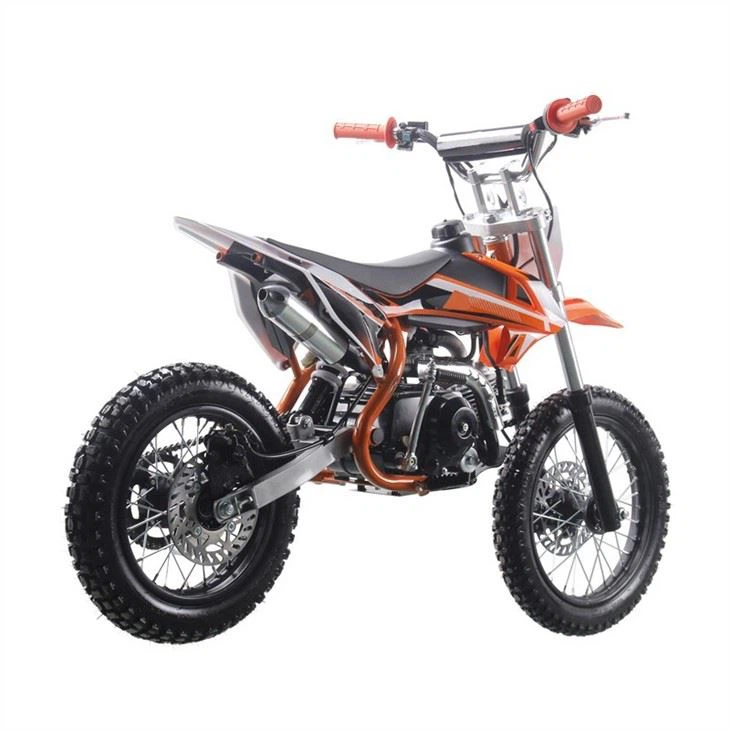
4-stroke 50cc bikes have a higher upfront price, but they’re cheaper to maintain over time. No need for special oil mix, longer engine life, and fewer repairs because of the smoother design. Plus, most 4-stroke 50cc models are designed with younger riders in mind—they have lower seat heights, automatic transmissions (check out this link for example: 110cc Automatic Pit Dirt Bike which is great for beginners) and simpler controls that are easy for kids to handle.
Wait, but what if you’re looking for a bit more power as your kid grows? A lot of parents transition their kids from 50cc to slightly larger engines as they gain experience. For example, once a kid is confident, you might upgrade to a 110cc model, which is a common next step. Our Pit Bike Mini Cross Motorcycle 110cc is a popular choice for older riders who have outgrown 50cc models, with a smooth power delivery that’s still easy to control. It’s worth noting that 4-stroke models are also more versatile for this growth phase; they can handle both casual trail riding and mild racing, whereas 2-strokes are better for more advanced, high-speed riding.
Now, let’s circle back to who each engine is best for. 2-stroke 50cc pit bikes are ideal for kids who have some riding experience, are more coordinated, and want a bike that’s lightweight and snappy for playing on trails or small tracks. They’re also a good fit if you’re someone who prefers minimal upfront cost and doesn’t mind regular maintenance (like mixing fuel and monitoring smoke).
4-stroke 50cc pit bikes, though, are the way to go for first-time riders, especially kids aged 4-8 who are still learning balance and throttle control. The smooth power, lower noise, easier maintenance, and added stability make them far less intimidating. I’ve worked with hundreds of families over the years, and almost every parent whose kid tried a 4-stroke first told me it made their child’s first riding experience far less stressful—and way more fun. A lot of these families later go on to upgrade to models like our Four Stroke 125cc Dirt Bike 110cc Air Cooled Pit Bike as their kid gains skills, since 4-strokes have the durability and power to grow with a young rider.
A common question I get is: can a first-time rider handle a 2-stroke? It’s possible, but it’s not recommended. The sharp power burst can lead to crashes if the kid over-rotates the throttle, and the higher noise level can make them nervous. I’ve seen kids as young as 4 get comfortable on a 50cc 4-stroke with a little training, whereas a 2-stroke is usually better for kids 7 and up who have already mastered balance on a smaller bike or a balance bike.
Another thing to consider is the type of riding your child will do. If you’re sticking to casual, low-speed trails or practice areas, a 4-stroke is perfect. If your kid wants to join small races or ride at higher speeds on more open tracks, a 2-stroke might be the better choice for the agility and power, but only if they have the experience to handle it.
At the end of the day, the decision between a 2-stroke and 4-stroke 50cc kids’ pit bike comes down to your child’s age, experience level, and riding style. As a supplier of 50cc Pit Bike for Kids, we don’t push one engine over the other—we work with parents to find what’s best for their kid. Whether you’re a parent shopping for your first bike, a small bike shop looking to stock beginner models, or someone interested in upgrading as your child grows, we’re here to help. If you have questions about our models, need guidance on which engine type fits your needs, or want to place an order to stock bikes for your shop, reach out to our team to discuss your requirements. We offer a range of 50cc and 110cc models, designed with young riders’ safety and ease of use in mind, so you can trust you’re getting a bike that will help your kid love riding.
References
- Society of Automotive Engineers. (2022). Two-Stroke vs. Four-Stroke Engine Performance for Small Displacement Applications. SAE International.
- Off-Road Motorsports Association. (2023). Kids’ Dirt Bike Safety and Engine Type Guidelines. ORMA.
- Cycle World. (2024). Beginner Riders’ Guide to Pit Bike Engines. Bonnier Media Group.
- American Motorcyclist Association. (2022). Youth Pit Bike: Selection, Maintenance, and Safety Standards. AMA Foundation.